🎹 Learning to Play
Piano, game music, and Ableton Live.
As part of my long-term goal of becoming a solo game dev, I decided to learn how to write music. This is a rather ambitious goal, as I have no prior music experience, other than playing the recorder in elementary/primary school.
Game Music
Though game music is called background music (BGM) and is usually instrumental (no lyrics), it’s an incredibly important part of video games.
Take for example, To The Moon, a touching story with simple graphics and minimal game mechanics. The writing and the music are what really drive the emotion and make it a memorable game.
Or as an anti-example, there is a point in Octopath Traveller II where music has left the world with little explanation. It’s so very odd to enter combat in a JRPG and not hear the music ramping up. It seems like it could be a bug, but apparently it was intentional.
Non-linear Music
Producing game music isn’t the same as most music because it’s non-linear and driven by the player’s actions. If a game has different music for the world map and a village, there’s no saying how long the player will stay in one particular area. The music needs to loop and transition based on what the player does.
How this is done varies from game to game, but there are largely two categories of how music can adapt.
Music can be split into parts horizontally in time. On sheet music, this may be like having a musical phrase followed by another musical phrase that repeats. Then the game can repeat the music as long as needed. In reality, game music may introduce more variation, so the music isn’t too repetitive.
To transition to another song, a game could just fade out one track and fade in another, but some games go the extra mile. For example, Monkey Island 2: LeChuck’s Revenge has music specifically written to trasition from one song to another. That’s a lot of short transitions that had to be written, integrated, and tested.
Music can also be split vertically. For example, as a song plays, events in the game could toggle particular instruments on and off.
If you’d like to learn more, Guy Michelmore has a video on the topic. To go even deeper, A Composer’s Guide to Game Music by Winifred Phillips is on my reading list.
Ableton Live 12
To produce music, one of the early decisions is which Digital Audio Workstation (DAW) to use. I decided to go with Ableton Live 12.
Ableton Live is well-regarded as a non-linear DAW for Electronic Dance Music (EDM). During live performances, DJs read the crowd and adjust the music using Ableton Live’s Session View. If people are having a good time, they may extend the track. If not, they can move on quickly. They accomplish this by having many loops prepared in advance, which are further organized into scenes that they can toggle on and off.
This way of thinking sounds very similar to game music. Unfortunately Ableton Live doesn’t have features specifically for game music, such as exports designed to work with popular game middleware (e.g. FMOD). Maybe they will add that in the future. 🤞🏻
Having tools designed to write non-linear music could be advantageous. But Ableton Live also has the Arrangement View (pictured above), which works more like linear DAWs.
Though it should go without saying, Ableton Live isn’t limited to dance music. For example, these videos by ZW Buckley and Guy Michelmore demonstrate that you can use Ableton Live 12 to write orchestral music.
Ableton sells three different editions of Live, as well as a Lite edition that is bundled with hardware. After testing the waters with the Lite edition, I decided to purchase the Standard edition, which lifts the track count limit.
Though I’m still learning how to use it, it can be pretty fun. With Spitfire Symphony Orchestra: Discover, you can even download an orchestra for free and play around with the different sections (strings, woodwinds, brass, and percussion). Or try playing a song with a choir like Originals Epic Choir. There’s a lot you can do.
A Keyboard
To produce music, it’s helpful to have an instrument! Last year I purchased a Kontrol S61 MK3, which is a rather fancy keyboard controller with 61 semi-weighted keys. The fully weighted 88 key version was too big and too expensive for my needs. Being a controller, it doesn’t actually produce any sound, but instead works with software on a computer or iPad. What makes it fancy?
- Dials and knobs provide a tactial way to adjust settings in software
- There is a screen above the dials to see which setting is being adjusted
- A Light Guide along the 61 keys to distinguish keyswitches that are used for playing other types of instruments, such as guitar
Native Instruments is the company behind this keyboard and software popular in music production. Unfortunately they have run into some financial trouble as of late. Hopefully they will survive and continue to support their products.
Learning Piano
There are a number of apps to learn piano. I tried a few, but being allergic to subscriptions, I decided to go with a book. Starting in January, I’ve been working through a page or two of Adult Piano Adventures each day. This always involves reading and playing music, taking a very gradual approach. There is the occasional short quiz as well.
French Minuet
My favourite song so far is this French Minuet by Jean-Philippe Rameau (arranged). I played quietly as instructed, but also very slowly (30 bpm).
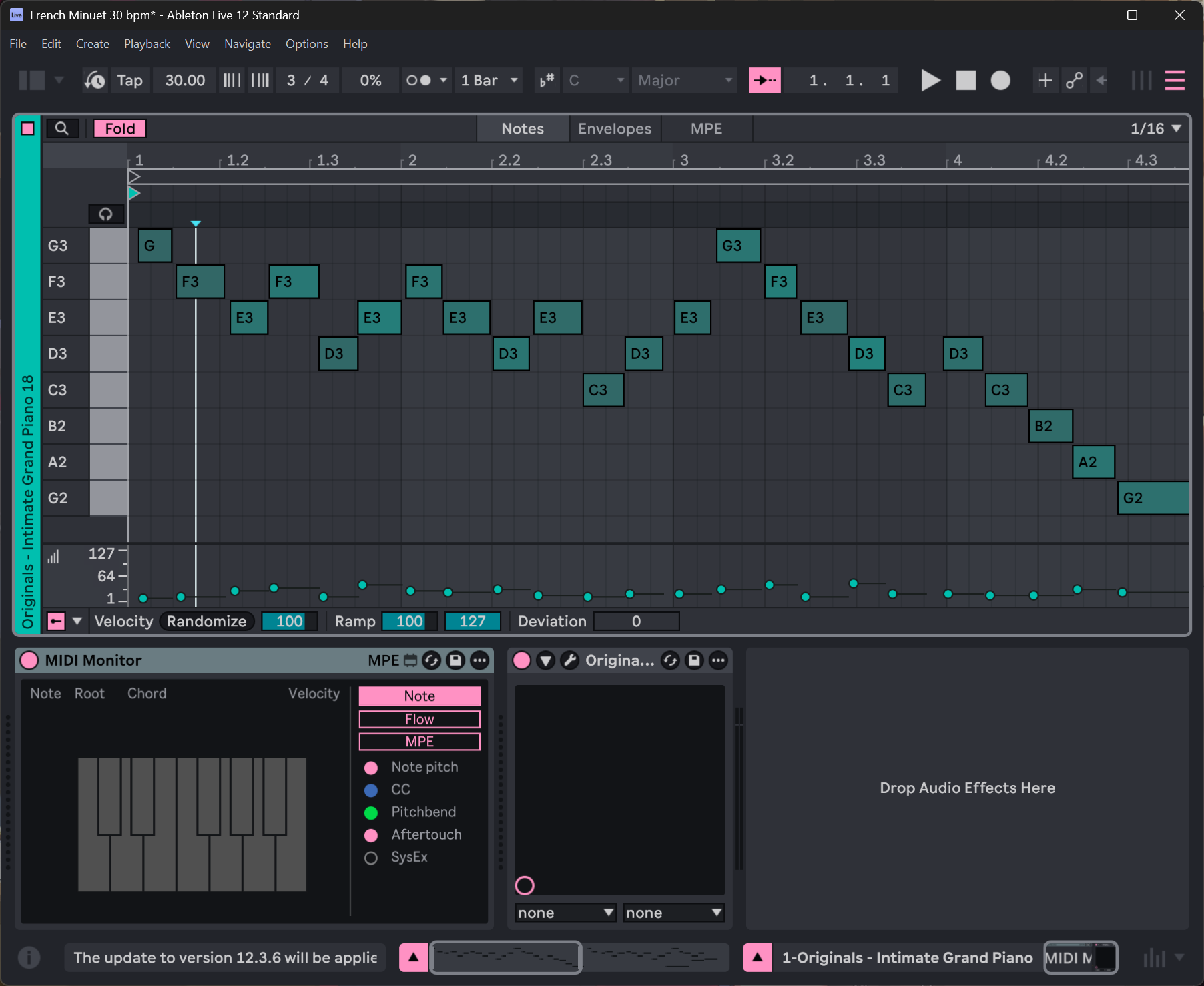
To record this song I used Ableton Live (pictured above). Choosing a specific tempo and making use of the metronome was helpful to work on my timing. After several takes, I was still a little off, so I made a few minor timing adjustments in Ableton.
What I didn’t do was quantize the music, which is a feature to automatically align the notes to the grid for perfect timing. This could sound too perfect and robotic, though Ableton does have options to nudge the notes towards perfect while keeping some of that human feel.
Challenges of Self-study
Adult Piano Adventures has been a great resource, though it is clearly intended to be used alongside an instructor. It has teacher duets that I simply skip.
I’ve had to turn to the Internet a few times, such as to better distinguish between ties and slurs, which both use curved lines. Though it covers some aspects of technique, there is a lot missing from the book that should really be taught early on, such as the alignment and flexibility of the wrists.
Fingering
As far as technique, the main thing Adult Piano Adventures provides is fingering. That is, which finger to use to play which note. The fingers are numbered from the thumb (1) outward to the pinky (5). These numbers will be written along the sheet music to provide guidance, but not to replace the need to read music (with the exception of the very first unit, which is simplified).
As an additional challenge, my ring finger (finger 4) doesn’t always do what I want, due to an old soccer injury that broke a bone in my left hand. Though finger 4 is still functional, I’m unable to use finger 3 and 5 together while lifting finger 4.
For example, the fingering for chord C E G on the bass cleff would usually be 1 3 5. But to avoid accidently pressing D as well, I need to substitute with 1 2 5. This has worked fine so far. It’s just something I’ve had to figure out and incorporate into my playing.
Performance
With self-study, I’m also responsible for noticing my own weaknesses and practicing those areas more. For example:
- I haven’t been practicing with a metronome, so I need to work more on maintaining rhythm.
- I find it difficult to play some passages louder (forte) or softer (piano).
- Now that the book has moved on to a different key, I’m terrible at sight reading once again. The landmarks I had memorized through practice no longer apply.
- I don’t know how to prevent a chord that’s held for 3 measures (with a tie) from decaying too soon, while playing a melody with the other hand. Maybe I need to review the section on pedals?
And that’s just the problems I know of.
Perhaps it’s fortunate that performance isn’t my goal. I’d like to play piano well enough to sketch out musical ideas in realtime, but I don’t need to be an expert pianist.
How Music Works
If you have any interest in music, I highly recommend the audiobook How Music Works by John Powell. It’s both entertaining and educational.
Near the beginning, he talks about how music differs from noise and the frequencies of notes, but without requiring a physics degree.
This helped me later on when I was learning suspended chords like Csus4 (C F G) in Adult Piano Adventures. As described, C F G builds tension that resolves down to C Major (C E G). I played the chords and heard the difference in sound, but I didn’t feel tension from C F G, and C E G didn’t feel resolved to me. But I could at least understand why that terminology was used due to how the frequencies of notes relate to one another. After some experimentation, I did find that ending a song with C Major certainly sounds better.
How Music Works also provides an introduction to instrumentation. When writing music with a keyboard, it’s pretty easy to play another instrument outside the bounds of what’s humanly possible. It’s important to know how each instrument is played by real musicians.
- Musicians need to breath, especially important for woodwinds and brass
- Guitars can play the same chord in many different ways, unlike piano
- Violins don’t have frets like guitars, so the expectations for a guitarist and a violinist are different
- And a lot more…
It was a very good read. It’s a book that I plan to revisit again.
Curriculum
For self-study, I need to design my own curriculum with a mix of courses and books. How do I choose from all the available resources?
Guy Michelmore is a composer I’ve already mentioned. He has a great YouTube channel and founded the online school ThinkSpace Education. And Spitfire Audio collborated with ThinkSpace to provide training using their sample libraries, including Spitfire Symphony Orchestra.
As for books, an interview with Ben Prunty (FTL, Into the Breach) praised Michael Miller’s book on music theory:
“…the best one I found was The Complete Idiot’s Guide to Music Theory. The guy who wrote it was amazing. He was able to explain it in this purely, wonderfully functional and logical way. It made more sense.”
So naturally, Michael Miller’s most recent music theory book, Music Theory: Note by Note, is on my reading list. I’ve already read a few chapters but the theory was getting ahead of what I could put into practice on piano. So I’ve decided to slow down and learn more or less in this order:
- Adult Piano Adventures book 1 and 2
- Ableton Live 12 by Simon Stokes on Udemy (started)
- How to Write Music and Learn Music Theory by ThinkSpace Education
- Music Theory: Note by Note by Michael Miller
- Introduction To Writing For Orchestra With SSO Discover by ThinkSpace Education (free)
Beyond that, I have a few guitar books by Barrett Tagliarino to learn instrumentation, even if I never buy a guitar (see the hand injury above). Also a book on Mixing Audio, and a few books specifically on game audio, including the aformentioned A Composer’s Guide to Game Music.
ThinkSpace Education has more courses on harmony and orchestration that I hope to buy down the road, but I already have my work cut out for me.
Plus music isn’t the only thing I’m learning. I’m also using Rebelle while studying art fundamentals.